HANACUP PROJECT / Sekkuden Co., Ltd.
Founded in 2005, Sekkuden is a small R&D company run single-handedly by its president, Megumi Sekkuden, with the help of fellow researchers and friends, to commercialize "Hanacup," which she invented. The "Hanacup Project" is a joint effort with the Tokyo Metropolitan Agriculture and Forestry Research Center, a seed company, flower growers in Tokyo, researchers and friends.
Hanacup is a plant for indoor display: the roots and growing medium of a flower seedling or foliage plant, grown in heat-sterilized coconut husk fiber, are wrapped in a drawstring fabric pouch. It is light and easy to handle. It can be hung on a wall or placed in a cup or on a plate, and with only watering, its flowers and appearance stay at their best for at least three weeks, while the plant itself lasts several months even for annuals and longer for perennials. Its greatest feature is that no soil is used at all, so it is hygienic indoors and can even be placed on a dining table or in a kitchen. When it withers, it can be disposed of as burnable waste.
The company has never borrowed money; R&D has been funded by its own capital and partly by public subsidies.
[History]
Sekkuden worked for many years as a contract designer for Tombow, a major school uniform maker. Seeing large amounts of uniform fabric being discarded every year, even unused, to prevent misuse, she felt it was "mottainai" (wasteful) and looked for a way to use it. She invented Hanacup and obtained a utility model registration (No. 3157340).
After receiving the first Yamamoto Ryoichi Award of the Ecomaterials Forum (Society of Non-Traditional Technology) for the invention in 2010, she entered the doctoral course of the United Graduate School of Agricultural Sciences, Iwate University in April 2011, and received a PhD in Agriculture from Iwate University in March 2014 for her research and development of Hanacup as a new form of indoor plant display.
She conducted joint research on Hanacup with the Tokyo Metropolitan Agriculture and Forestry Research Center. After obtaining her degree, she launched the "Hanacup Project," a research group for commercializing Hanacup, with researchers from the center, Chiba Institute of Science and Salesian Polytechnic, as well as the seed company M&B Flora, flower growers in Tokyo and the social welfare corporation Asunaro Fukushikai, which has met almost monthly since then. The trademarks "花活布" (2016, No. 5840234) and "hanacup" (2021, No. 6444201) have been registered.
[Business]
After much research and trial and error, Hanacup was ready for commercialization in 2018, and sales activities began with exhibitions at flower trade shows. At the invitation of the Ministry of Justice and the Tokyo Metropolitan Government, it was sold at events in 2019 and almost sold out. Sales activities were suspended for over two years due to the COVID-19 pandemic from early 2020.
In February 2022, Hanacup won both the Excellence Award and the Takeya Award at the "Tokyo TASK Monozukuri Award 2021," jointly held by five municipalities including Taito and Arakawa wards. Sales activities gradually resumed; through the Gift Show, several major business partners including JA Tokyo were acquired, and direct sales are made at events.
Currently, Hanacup is sold together with T-NET vigla Co., Ltd. (Takamatsu) at in-station pop-up sales (Urawa, Omiya, Ikebukuro, Shinagawa) and at the Taito City Industrial Fair. Online sales are through BASE, and it is regularly sold at Vegelabo Yanagibashi.
Since Hanacup itself was born from the spirit of "mottainai," the company focuses on outreach classes in which mainly elementary school children learn "the importance of greenery and the fun of making things" by making their own Hanacup. The classes are popular, and the parent-child course at the Chuo City Environmental Information Center is now in its third year.
Exhibitor Information
HANACUP PROJECT
Booth No. :
3-046
Exhibition Details
Hanacup is a flower seedling or foliage plant wrapped in a palm-sized fabric pouch for indoor display, letting people enjoy real greenery in daily life. No soil is used, so it is hygienic and can be thrown away as burnable waste. We exhibit and sell Hanacup and hold a workshop where visitors choose a seedling and fabric to make their own. Inquiries from companies are welcome.
Exhibition Area and Categories
Exhibition Area
Exhibition Category
Environmentally conscious aspects
- Improving materials used in manufacturing
- Reducing the amount of waste at the time of disposal
Feel flowers and greenery closer in your daily life with Hanacup.
-
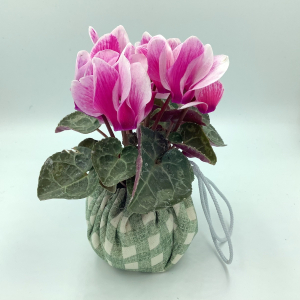 No soil is used, so it is hygienic. Hang it or put it on a table; just water it now and then to enjoy it long.
-
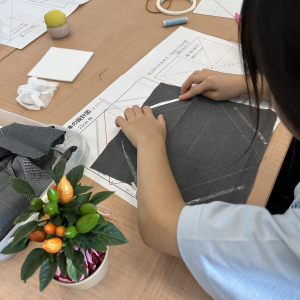 Pick a seedling and fabric, wrap it, and your own Hanacup is ready in about 10 minutes. Take it home in a gift package.
Corporate Information
| Section | |
|---|---|
| Address | Asakusabashi Am Flat 2 #502, 3-3-2 Asakusabashi, Taito-ku, Tokyo 111-0043, Japan |
| Phone | 03-3861-7270 |
| hanacuppj@gmail.com | |
| URL | https://hanacup.info |