Akita COI-NEXT, led by Akita Prefectural University, is a project selected under JST’s COI-NEXT program.
Against the backdrop of population decline and the resulting contraction of regional communities, the project seeks to establish a new circular system for revitalizing the regional economy and industry. By diversifying the use of Akita’s rich forest resources, it aims to pass on local resources and technologies, foster the exchange of people and culture, and stimulate broader socio-economic activity.
The consortium consists of 24 organizations, including Akita International University, Akita University of Art, Q0 Inc., the Sustainable Management Promotion Organization, and Akita Bank as managing institutions, alongside additional private-sector and public partners within and beyond the prefecture.
Since FY2024, the project has accelerated a wide range of research and development efforts that create new value from Akita’s abundant forest resources, supported by JST funding and complemented by private-sector investment, technologies, and human resources.
By integrating the technical capabilities of Akita Prefectural University, the liberal arts strengths of Akita International University, and the design expertise of Akita University of Art—together with the research capacity of partner institutions, the administrative capabilities of local governments, and the implementation power of private companies—the project aims to build a new hub where “self-sustaining prosperity” can emerge.
Through the creative integration of five domains—forest and space, forest and wood, forest and towns, forest and craft/technology, and forest and people—the project strives to pioneer new value and new forms of regional circulation.
Exhibitor Information
AKITA COI-NEXT (AKITA PREFECTURAL UNIVERSITY)
Booth No. :
F-02
Exhibition Details
Akita COI-NEXT is a research and innovation project under JST’s COI-NEXT program, led by Akita Prefectural University with 24 partner institutions.
We introduce “Akita Mokumaru,” a super compact BEV made with a wood-fiber composite resin derived from Akita cedar. As a mobile vision model, the vehicle embodies the social implementation of our research and reconnects everyday life with the forest.
Exhibition Area and Categories
Environmentally conscious aspects
- Improving materials used in manufacturing
- Reducing energy/water use during manufacturing
- Reducing waste/emissions during manufacturing
- Saving energy/water use during customer use
- Lowering pollution/emissions during customer use
- Reducing the amount of waste at the time of disposal
- Reducing hazardous substances and pollution emitted by waste disposal
- Displaying environmental information
- Extending product life
Future mobility from forest materials. Discover new possibilities of wood.
-
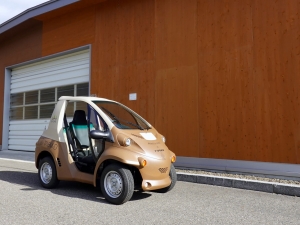 “Akita Mokumaru” is a super compact BEV using wood-fiber composite — a mobile vision model linking forest and life.
 -
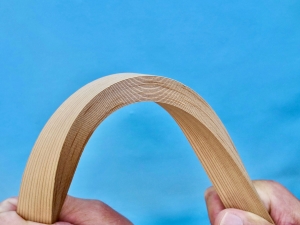 Wood can be this flexible.
Discover an innovative material experience at our booth.
Corporate Information
| Section | Institute of Wood Technology, Akita Prefectural University |
|---|---|
| Address | Kaieizaka 11-1, Noshiro, Akita, JAPAN |
| Phone | 0185-52-6900 |
| info@akita-souzounomori.com | |
| URL | https://en.akita-souzounomori.com |